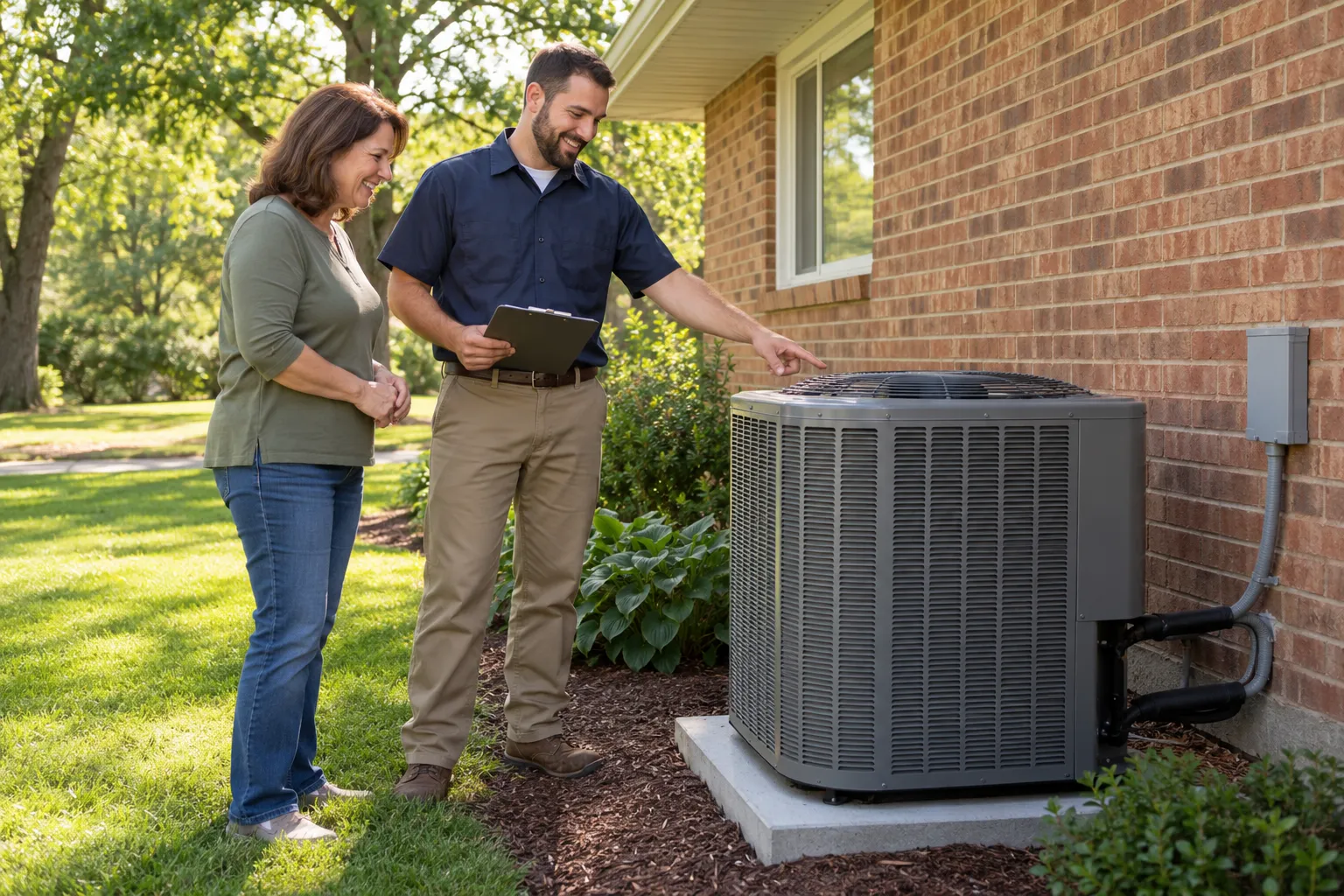
A failing air conditioner is stressful, especially in a hot, humid summer. Replacing it is a big decision, and rushed choices can be expensive. This page explains the warning signs, the system types, and what a proper installation includes, in plain words.
Defendingloaded Heating & Air is a referral service. We do not install or replace anything ourselves. We connect homeowners across the St. Louis area with independent HVAC providers in our network. The provider does the work, sets the price, and gives you a written quote. You decide whether to move forward, and there is no obligation to hire anyone.
Stay safe first if the system is failing
If your AC quits during a heat wave, protect people before you think about equipment. Move everyone to the coolest room, drink water, close the blinds, and check on older relatives and small children.
- Do turn the system off at the thermostat if you smell burning.
- Do switch off the breaker if you see sparks or water near electrical parts.
- Do not keep resetting a tripped breaker.
- Do not open the outdoor unit panel yourself.
If the unit is simply broken and not dangerous, a provider can tell you whether emergency AC repair or a full replacement makes more sense.
Is it time for a new AC?
Age is the first clue. Many central systems last about 12 to 15 years, though hard use and poor upkeep can shorten that. A repair bill that nears half the cost of a new system is a common point to compare both choices.
Ask the provider to put the repair option and the replacement option side by side, in writing. Then you can decide with real numbers instead of pressure.
Signs your AC may need replacing
- The system is over a dozen years old and needs repairs often.
- Summer bills keep climbing with no change in how you use it.
- Some rooms stay warm while others feel cold or clammy.
- The air feels sticky even when the unit runs all day.
- The outdoor unit is loud, rusted, or leaking refrigerant.
- Your system uses an older refrigerant that is getting harder to find.
One sign alone does not mean replacement. Several together are worth a closer look.
Types of cooling systems
Most homes with ductwork use a central split system: an outdoor condenser and an indoor coil. It is common in frame houses and ranch homes.
A heat pump cools in summer and heats in winter. It can suit homes that want heating and cooling from one setup, though cold winters with deep frost can affect the choice.
Ductless mini-splits work well for bungalows, additions, or homes with no ducts. A packaged unit puts everything outdoors in one cabinet.
Why proper sizing matters
Bigger is not better. An oversized unit cools the air fast, shuts off, and leaves moisture behind. In humid summers that means a clammy home and a system that starts and stops too often, which wears parts out.
A good provider measures your home, checks insulation, windows, and ducts, and runs a load calculation. Do not accept a size picked only by looking at the old unit.
Request a callback to check provider availability for a sizing visit.
What an AC installation includes
A complete job is more than setting a box outside. Ask whether the quote covers:
- Removing and disposing of the old unit and recovering its refrigerant
- A new pad or stand, lines, and electrical connections
- A new or checked indoor coil, drain line, and condensate setup
- A thermostat that works with the new equipment
- Startup testing, airflow checks, and permits where required
The provider does the work. Defendingloaded Heating & Air does not perform any of these steps.
Matching the system
The indoor and outdoor parts should be rated to work together. A mismatched coil can cut performance and may affect warranty terms. Ask for the model numbers of every part.
If your furnace is also aging, some homeowners start searching for furnace replacement near me and wonder about doing both at once. A provider can explain whether replacing the whole heating and cooling setup together saves trouble, or whether one part can wait.
Older frame houses may also have ducts that are leaky or too small. Fixing ducts can matter as much as the new unit.
Efficiency in plain terms
Efficiency is shown as a SEER2 number. A higher number means the unit uses less power to deliver the same cooling. A higher number usually costs more up front, so the savings take time to add up.
If your summers are long and hot, a more efficient unit may pay off sooner. If you cool only a few weeks a year, a mid-range model can make more sense. Ask the provider to show estimated running costs.
How the price gets built
The total depends on the unit size, the system type, the brand, and how much ductwork or electrical work is needed. Access matters too. Tight crawl spaces and tricky basements take more labor.
Quote in writing. A good quote lists the equipment, the labor, the extras, the warranty, and the total. Be careful with a vague number given over the phone.
How Defendingloaded Heating & Air fits in
Here is how it works, with nothing hidden. You reach Defendingloaded Heating & Air, and your request is routed to an independent provider in our network. That provider speaks with you, visits if needed, and gives you a quote. Defendingloaded Heating & Air does not set prices, do the work, or take part in your contract.
We cannot promise timing or price. Availability varies by provider, so ask directly when you speak with one.
Questions to ask the provider
- Are you licensed and insured to work in my state?
- Did you do a load calculation, and can I see it?
- What is the full model number of each part?
- Is the old unit removal included?
- What does the parts and labor warranty cover?
- Who handles permits and inspections?
- What happens if the first startup test shows a problem?
Take notes on each answer. Compare at least two written quotes before you choose.
What's Included
Old unit removal
The provider disconnects the old system, recovers refrigerant the proper way, and hauls away the equipment.
New equipment
Matched indoor and outdoor parts are set, connected, and sealed to the maker's specifications.
Electrical and lines
Wiring, disconnects, refrigerant lines, and drain lines are checked or replaced as needed.
Startup testing
Airflow, pressure, and cooling output are tested before the job is called finished.
Typical AC replacement costs
These are typical U.S. ranges, and real prices vary by home, system type, and provider. Use them for planning only, and ask for a written quote before agreeing to any work.
| Item | Typical range | Notes |
|---|---|---|
| Central AC replacement | $5,000 – $12,000 | Depends on size, brand, and efficiency rating |
| Heat pump system | $6,000 – $14,000 | Cools and heats; cold climates may need extras |
| Ductless mini-split (one zone) | $3,000 – $7,000 | Good for homes with no ducts |
| Ductwork repair or changes | $500 – $3,500 | Older homes often need sealing or resizing |
| Electrical and permit work | $200 – $1,500 | Varies by local rules and panel condition |
| New thermostat | $150 – $600 | Smart models cost more to install |
How It Works
Share your situation
Request a callback or send the request form to describe your system, your home, and your concerns.
Get matched with a provider
Your request is routed to an independent provider in our network who serves your area.
Review the written quote
Compare equipment, labor, extras, and warranty details line by line before you decide.
Choose and schedule
If you agree, you set the install date directly with the provider you pick.
Why Call Defendingloaded Heating & Air
Clear referral model, no surprises
We tell you plainly that independent providers do the work and set their own prices.
Safety guidance
Simple do and do-not tips help you avoid common, costly mistakes.
Written quotes
We encourage every homeowner to get itemized quotes before agreeing to any job.
No obligation
Requesting an estimate does not commit you to hire any provider.
Other Services
Need ac installation & replacement services in St. Louis?
Have an AC or furnace problem? Send a request or call, and we will route you to an independent provider in our network. No obligation.
No obligationAC Installation & Replacement Services FAQ
How do I know if I should repair or replace my air conditioner?
Look at age, repair history, and the cost. A unit over 12 years old with a pricey repair is often worth comparing against replacement.
How long does an AC installation usually take?
Many standard swaps take about one day, but ductwork changes or tricky access can add time. Ask the provider for a schedule in writing before work starts.
Does homeowners insurance pay for a new air conditioner?
Some policies may cover sudden damage, such as a storm or hail event, but normal wear usually is not covered. Check your policy, and a provider can often help document damage.
Get in touch
Have an AC or furnace problem? Send a request or call, and we will route you to an independent provider in our network. No obligation.
No obligation